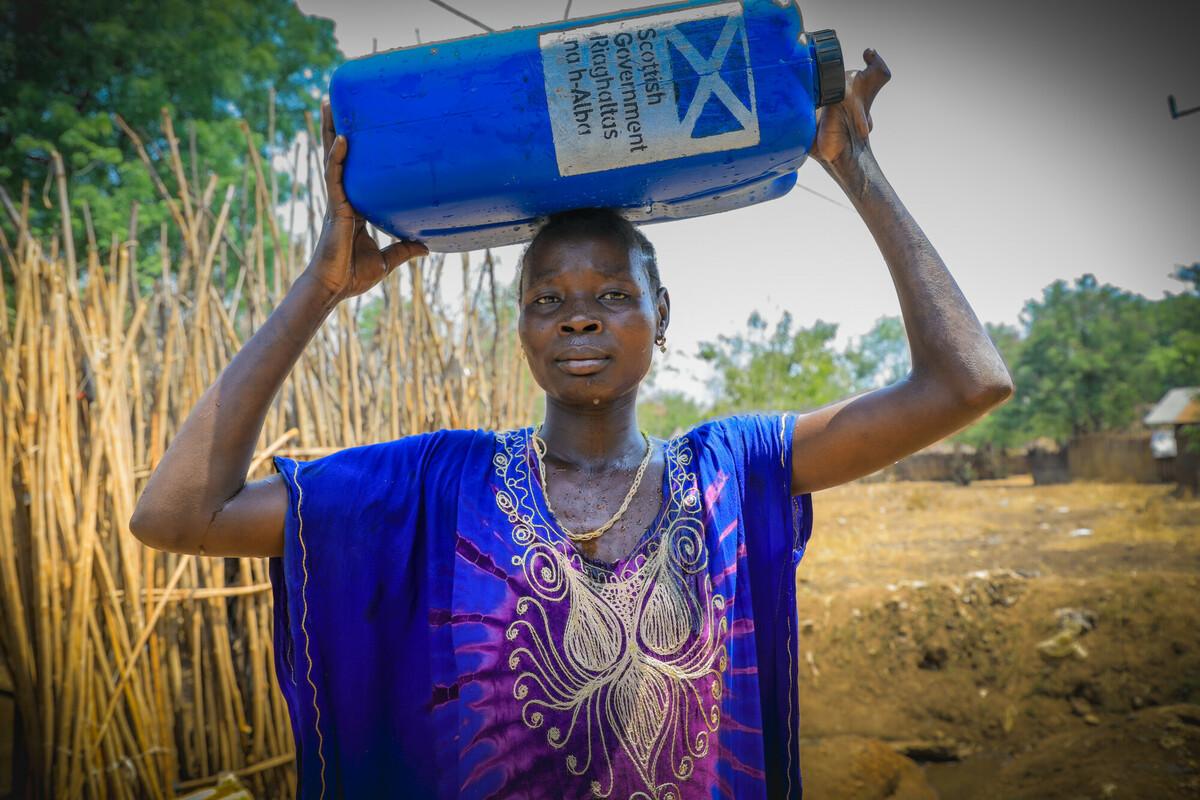
Ethiopia: Adugk, 35, fled the conflict in South Sudan to find refuge in Gambella. With the help of Oxfam, she is able to easily access and collect water. Photo: Liban Hailu/ Oxfam.
Water scarcity and access to clean water
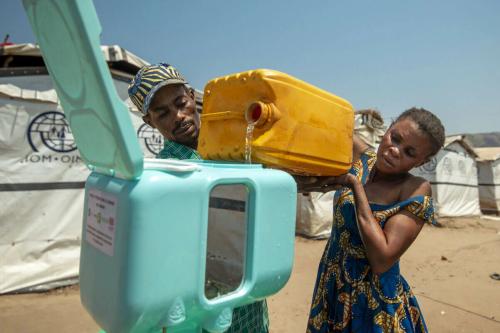
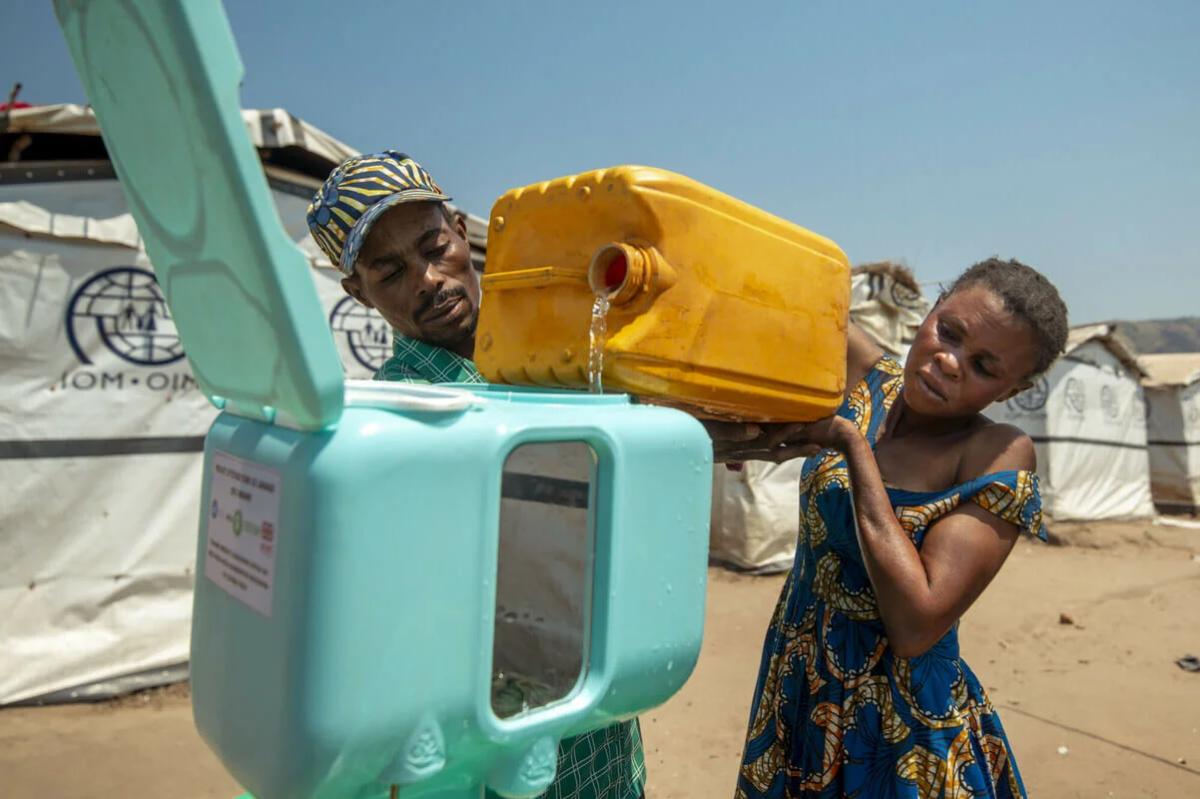
Democratic Republic of Congo. Nombe fills up the hand-washing tank with water. Credit: Arlette Bashizi/Oxfam
It’s all too easy to forget what a miracle water is. With a water supply on tap, food can grow, and people can thrive. Water is life.
Yet access to clean water and safe sanitation — flushing toilets, and other forms of sewage treatment — is one of the biggest health issues around the world. Almost 900 million people in the world do not have access to clean water — or one in eight people (WHO/UNICEF).
Unclean water, poor sanitation and unsafe hygiene practices have claimed more lives over the past century than any other cause. This is continuing in many low-income countries, making this one of the world’s most urgent health issues.
As part of our humanitarian response work, Oxfam is widely recognized as a leading organization helping people meet their needs for clean water, safe sanitation and hygiene advice (collectively known as WASH).
Our water engineers are renowned for their speed and efficiency, providing large-scale water supplies and disease-preventing sanitation facilities to millions of vulnerable people in the world, even in the most challenging environments such as after the 2023 Türkiye-Syria earthquake and the 2022 Pakistan floods.
Working alongside partners on the ground, we are committed to developing innovative, long-term and cost-effective solutions that are tailored to each community’s unique needs and can reduce levels of poverty and disease.
In emergencies, many more lives are put at risk by inadequate water supplies and poor sanitation. It’s estimated that, at the bare minimum, a person needs 15 litres of water per day for drinking, cooking, and washing. This makes providing clean water a massive task requiring the sort of specialist skills and equipment Oxfam has.
The costs of unsafe water
2.2 billion
people do not have access to clean water at home.
2.3 billion
people lack access to basic sanitation services, such as toilets.
Over 80%
of all wastewater worldwide returns to the environment without being treated.
800+
children under the age of five die daily from diarrhea-related illnesses linked to contaminated water.
700 million
people worldwide could be displaced by intense water scarcity by 2030.
Four billion people worldwide experience severe water scarcity for at least one month every year. And the number is growing. This page explains what water scarcity is, what causes it, what it does to people's lives, and what can be done about it — including the work Oxfam does alongside communities on the frontline of global water crises.
What is water scarcity?
Water scarcity occurs when the demand for water in a region is larger than the available, safe supply. It can have physical or economic drivers.
Physical scarcity
Physical scarcity is when there simply isn't enough water to meet demand. We see this most often in arid or drought-affected regions.
Economic scarcity
Economic scarcity is different: the water exists, but people can't reach it. That can be because of poor infrastructure, a lack of investment, or water resources that are poorly managed and left unsafe to use. It’s rarely just bad luck. Economic water scarcity reflects inequality — who has power over a shared resource, and who is left out of the decisions about how it's managed.
These terms sit on a spectrum. Water stress describes early pressure on supply. Water scarcity is more severe and sustained. A water crisis is an acute collapse in access to water — the kind Oxfam responds to directly in places like Lebanon, Syria, Yemen and other areas across the Middle East.
What causes water scarcity?
Climate change
Climate change is shifting rainfall patterns, lengthening droughts and making weather more erratic, reducing and destabilising water supplies in many regions.
Population growth and urban demand
Population growth and urban demand lead to more people needing more water for drinking, sanitation, industry and agriculture. Often in areas that are already struggling to supply clean water to everyone. The demand for water can quickly grow faster than supply can keep up.
Agricultural overuse
Agricultural overuse is significant: agriculture accounts for around 70% of global freshwater use. Inefficient irrigation and water-intensive farming place enormous pressure on our rivers, lakes and groundwater.
Pollution
Pollution removes otherwise usable water from the supply, even where rainfall is adequate. Contamination from industrial waste, agricultural run-off and inadequate sanitation can make existing water unsafe to use.
Poor or ageing infrastructure
Poorly managed infrastructure can stop people accessing clean water. Leaking pipes, broken pumps and outdated treatment systems are compounded by chronic underinvestment.
Conflict
Conflict drives water scarcity, and water scarcity drives conflict. Research indicates that in Yemen, 70-80% of rural conflicts are water-related. Scarcity fuels disputes over what little water remains, and conflict then destroys the infrastructure used to treat and transport water. A cycle that deepens with each turn.
In Lebanon, most water systems depend on diesel-powered pumps, meaning a fuel shortage can shut off water just as effectively as a drought.
None of these causes exists in isolation, and none of them is inevitable. Behind almost every cause of water scarcity is a choice about infrastructure investment, land use, or who holds power over a resource everyone depends on.
What are the effects of water scarcity?
Health risks and disease
Health risks rise sharply when clean water is scarce, as people are forced to rely on unsafe sources. Cholera, dysentery and typhoid all spread more easily without clean water — Oxfam's Yemen reporting has documented how scarcity and conflict together have driven cholera outbreaks in recent years.
Food insecurity and crop failure
Food insecurity and crop failure follow closely behind: without reliable water, crops fail and livestock die, undermining the food systems entire communities depend on. In the most extreme cases, water scarcity is one of the structural drivers behind famine itself.
The time burden on women and children
The time burden on women and children is significant and often overlooked. In many communities, women and children are responsible for collecting water, sometimes walking for hours each day to reach a safe source.
In Yemen, Rawya Sultan Al-Maqtari walked long distances every day for water that wasn't reliably safe to drink. UNICEF has found this burden falls hardest on girls, directly affecting school enrolment and attendance, and exposing children to safety risks along the way.
Environmental degradation
Water scarcity doesn't only affect people. WWF's Living Planet Report found freshwater species populations have declined 85% since 1970, which is the steepest decline of any ecosystem. These species live in the same rivers, wetlands and groundwater systems that people depend on and which are being drained, dammed and polluted.
Water scarcity and poverty reinforce each other. Communities without reliable water lose the time, health and stability needed to build economic security. And the communities already living in poverty have the least capacity to adapt when water becomes scarce.
Water scarcity solutions
Water-use efficiency and conservation
A solution to agricultural overuse is to use water more efficiently when irrigating. Improving irrigation efficiency and reducing water waste across farming, industry and households can ease pressure on supply without requiring new water sources.
Infrastructure repair and leak reduction
Ageing pumps and leaky pipes are a common cause of poor infrastructure — one of the core drivers of economic scarcity. Fixing vital treatment systems and distribution networks means water can better reach the people who need it.
Desalination and water recycling
Desalination and water recycling can help address physical water scarcity, particularly in coastal and arid regions. Turning seawater or wastewater into a safe, usable supply is increasingly viable, but it requires energy and investment that many affected communities can't provide alone.
Protecting wetlands and natural water systems
Protecting wetlands and natural water systems reduces environmental degradation and improves long-term supply. Healthy rivers, wetlands and groundwater systems act as natural storage and filtration. And protecting them is usually more cost-effective than engineered alternatives.
Community-led WASH programs
Community-led WASH programs address the compounding effects on people’s health and daily life. Locally-led water, sanitation and hygiene programs — the kind Oxfam and partners deliver directly — combine infrastructure with the community knowledge needed to make solutions last.
Solving water scarcity requires all of these approaches working together — global investment and technology, alongside the community-led work that ensures solutions reach the people who need them most. This is exactly where Oxfam's work begins.
Oxfam’s work with water and sanitation
It’s all too easy to forget what a miracle water is. With a water supply on tap, food can grow, and people can thrive. Water is life.
Yet access to clean water and safe sanitation — flushing toilets and other forms of sewage treatment — is one of the biggest health issues around the world. 2.1 billion people in the world do not have access to clean water — or one in four people.
Unclean water, poor sanitation and unsafe hygiene practices have claimed more lives over the past century than any other cause. This is continuing in many low-income countries, making this one of the world’s most urgent health issues.
As part of our humanitarian response work, Oxfam is widely recognised as a leading organisation helping people meet their needs for clean water, safe sanitation and hygiene advice (collectively known as WASH).
Our water engineers are renowned for their speed and efficiency, providing large-scale water supplies and disease-preventing sanitation facilities to millions of vulnerable people in the world, even in the most challenging environments such as after the 2023 Türkiye-Syria earthquake and the 2022 Pakistan floods.
Working alongside partners on the ground, we are committed to developing innovative, long-term and cost-effective solutions that are tailored to each community’s unique needs and can reduce levels of poverty and disease.
In emergencies, many more lives are put at risk by inadequate water supplies and poor sanitation. It’s estimated that, at the bare minimum, a person needs 15 litres of water per day for drinking, cooking, and washing. This makes providing clean water a massive task requiring the sort of specialist skills and equipment Oxfam has.
The costs of unsafe water
2.1 billion
people do not have access to clean water at home.
3.4 billion
people lack access to basic sanitation services, such as toilets.
44%
of domestic wastewater worldwide returns to the environment without being treated.
1200+
children under the age of five die daily from diarrhea-related illnesses — 60% of those are linked to unsafe water, sanitation and hygiene.
700 million
people worldwide could be displaced by intense water scarcity by 2030.
What we do
Emergency response
Fast action can stop an emergency turning into a crisis. Our water engineers are renowned for their speed and efficiency, providing large-scale water supplies and disease-preventing sanitation facilities — even in the most difficult circumstances such as the Syrian earthquake and the flash flood in Nepal.
In each situation, we look for the most effective and efficient way to provide water — setting up delivery systems that pipe or truck water in from the nearest water source for distribution via water tanks, pipes and tap stands.
We always work with local people; taking into account local needs and practices. We ensure that facilities are designed to enable people — particularly women and children — to maintain their dignity and stay safe. We also provide health and hygiene advice to ensure water and sanitation facilities are used properly to help prevent the spread of disease.
Long-term development
Water, sanitation and hygiene approaches underpin many of our anti-poverty development projects. We work with local communities to provide long-term, cost-effective solutions that can reduce levels of poverty and disease.
Providing safe water can improve general health and reduce the pressure on often-limited health care resources.
Introducing simple irrigation schemes can kick-start farming, improve local diets and give people the chance to make a living.
By taking an integrated approach to health and incorporating components from the fields of water, sanitation and hygiene (WASH), we can provide simple and effective solutions that can be implemented by local communities themselves.
Providing clean water, latrines and hygiene advice at schools can even increase attendance, reducing days lost through illness and raising educational performance. This can be particularly significant for girls. Schools play an important role in helping to change attitudes towards hygiene within their wider community.
Water for life
Oxfam is providing clean water, sanitation and hygiene education to communities around the world. In fact, it is one of the things we do best — our solutions are saving lives.
Running taps, working toilets, clean, safe drinking water and soap — in Australia, they’re things people can take for granted. Yet around the world, millions of people get sick or die each day because they must go without these necessities of life.
2.1 billion people in the world do not have access to clean, safe drinking water, while 3.4 billion live without basic sanitation. 1.4 million people die each year as a result of inadequate drinking-water, sanitation and hygiene (World Health Organisation).
Oxfam and our local partner’s water engineers and public health specialists are known internationally for the speed and efficiency with which they can help provide large-scale water supplies, essential sanitation facilities and hygiene improvements, even in the most difficult circumstances.
We integrate our water and sanitation solutions with hygiene in an evidence-based practice known as “WASH”. The World Health Organisation attributes about 70% of diarrhoeal diseases to poor access to WASH infrastructure.
Emergencies
When disaster strikes, Oxfam acts quickly to save lives by delivering clean water and sanitation — from simple solutions like distributing buckets, jerry cans, soap and water purification tablets, to building and rehabilitating water supply systems, providing tanks, delivering clean water and constructing toilets.
This goes hand-in-hand with educating people about the importance of washing hands, collecting water in clean containers, storing water safely and purifying water for drinking and cooking.
Oxfam was one of the first aid agencies to use specialised water treatment units that purify vast amounts of water in a very short time — up to 6,000 litres an hour. Other agencies began using similar technologies following Oxfam’s example.
After Typhoon Kestana flooded large parts of Manila in the Philippines in September 2009, our solutions included building a new prototype “floating” toilet to help ensure people staying in evacuation centres had adequate sanitation facilities.
In Yemen, where conflict has made diesel fuel unreliable and unaffordable, Oxfam has installed solar-powered water systems. These systems eliminate fuel dependency and keep water flowing even when traditional supplies fail.
One of Oxfam’s greatest water innovations is also one of its most simple — the Oxfam bucket, which we distribute to displaced people during emergencies. Winner of a Millennium Design Award, the bucket is designed to be light, durable, and keep water clean and safe. It stacks, is easy to transport, has a tight-fitting lid to keep out the dirt and prevent spillage, and an insertable tap to prevent collected water from being recontaminated. The plastic is UV resistant to prevent algal build-up.
Vasantha Nilaweera was one of thousands of displaced people living in temporary camps in Sri Lanka after the 2004 tsunami who experienced Oxfam’s comprehensive water response.
“Oxfam gave training to everyone in safety and hygiene,” Vasantha recalls. “They gave us water filters and we took water from two separate tanks — one for drinking and one for washing. People from Oxfam also came to check the quality of the water.”
Long-term solutions
In the context of our long-term development work, Oxfam provides water, sanitation and hygiene solutions that are tailored to local needs, conditions and technologies.
We drill boreholes, sink wells, install tanks, pumps and tap stands, construct entire gravity-fed water supply systems and small-scale irrigation schemes, build toilets, set up household water treatment solutions, promote the production and use of soap and promote safe hygiene practices in homes and schools.