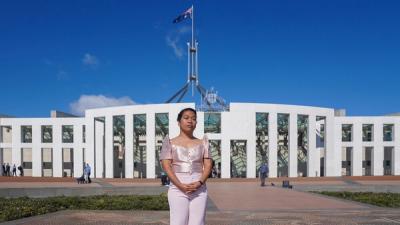
Australia: Four climate activists from the Kimberley, the Philippines and the Solomon Islands came together for the Safe Climate, Equal Future Speakers tour in September 2024. Photo: Heidi Demond/Oxfam
How federal politicians are elected and how governments are formed
Members of the House of Representatives and the Senate are elected in different ways.
How Members of the House of Representatives are elected
Members of the House of Representatives are elected for a term of three years using the ‘preferential’ voting system.
Voters are required to rank each candidate in order of preference by placing numbers next to their names on the ballot paper. So, for example, if there are five candidates, voters will be required to number the candidates in order from one to five.
In the first stage of counting, the first preference votes are totaled and if one of the candidates receives more than half the votes, then they are elected. However, if there is no majority, then the candidate with the fewest votes is eliminated and those voters are redistributed based on the voter’s preferences.
If the candidate who received the voter's first preference is eliminated during the first count because they received the lowest number of votes, the vote will then be allocated to whichever candidate was the voter’s second preference. If this candidate is also eliminated, the vote will be allocated to the voter’s third preference, and so forth until there are only two candidates remaining. The winning candidate will be whichever of these candidates wins the most votes after all preferences have been allocated between the two remaining candidates.
Preferential voting is used in the House of Representatives because it is designed to result in the election of a person who receives the broadest support from the electorate, even though that person may not be the first choice of the majority of voters in the electorate.
The use of the preferential voting system makes it difficult for independents and minor parties to secure seats in the House of Representatives. The proportion of women in the House – currently 69 out of 150 seats – is also negatively impacted by this voting system. This is because most successful candidates are members of the two major parties, so the number of women elected depends on the number of women preselected by the major parties to stand as candidates.
How senators are elected
Australian politics is known as a two-party system. This is as a result of the system of voting used to elect MPs to the House of Representatives.
It is almost inevitable that either the Coalition (comprising the Liberal, Country Liberal and National parties), or the Labor Party will win a majority of seats and therefore be eligible to form government.
Nevertheless, smaller parties and parliamentarians who are not linked to any political party – known as ‘independents’ – are also represented in the Federal Parliament. In the 46th Parliament, there are two Independents and three minor party members in the House, and nine Greens and 11 other minor party members in the Senate.